Case strength and damages
A case strength assessment and damages range, checked line by line
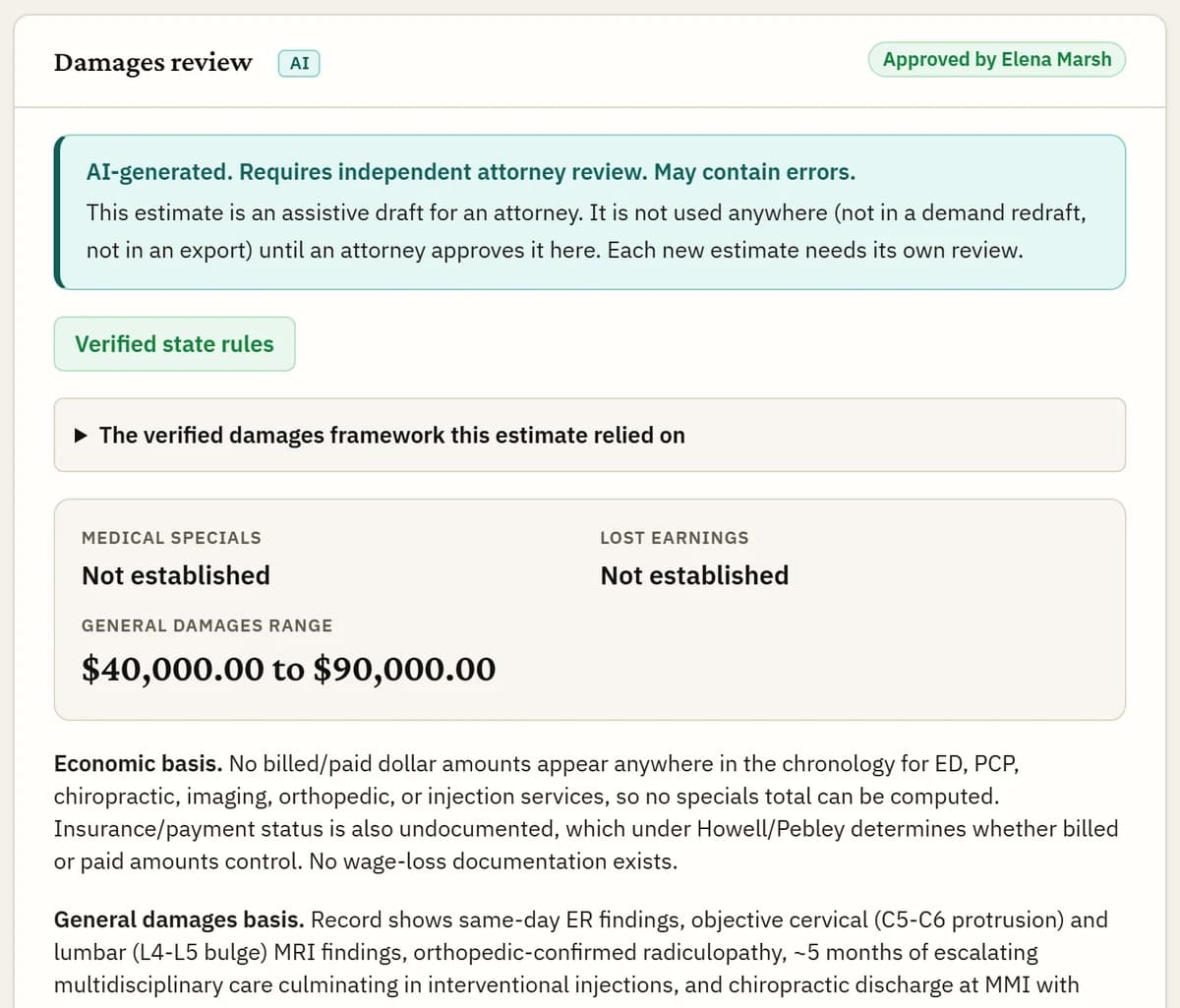
The strength assessment names what supports the case and what cuts against it, each with its page. The damages range rests on a stored, cited legal basis and a specials figure from the bills, and nothing uses it until your attorney approves it.
- This page01AI draftcited to pages
- 02Attorney reviewedit, approve or reject
- 03Approvedexport, demand, report
- 04Clientnever sees AI output
Who this is for
Attorneys and partners valuing a case and deciding what to pursue, at personal injury firms; the strength assessment serves employment cases too. The California personal injury deadlines guide covers the dates behind a claim, and strength and damages are on every plan (pricing).
The strength assessment
An assessment of the record for your attorney’s working notes: a score out of 100, a band (weak, moderate or strong), a short summary, and the points that support the case and the points that cut against it, each cited to its page. When the record is too thin, it says what is missing instead of giving a score.
It describes the evidence: how clear liability is, how the documented injuries fit the incident, treatment continuity, objective findings, permanency and work restrictions, and the quality of the records. It is not a prediction of outcome, and it never puts a figure on the case.
Your attorney can edit the score, the band and every point before approving the analysis. The strength assessment is not given to the demand drafter.
A damages range on a stored legal basis
Brennick estimates damages only on a stored, cited legal basis for the case’s state and case type, and every estimate records which basis it used.
The stored summary is the model’s only legal authority. Each estimate lists its assumptions, its caveats and a confidence level of low, moderate or high.
Verified for California
California’s damages rules are verified. Estimates there are labelled “Verified state rules”.
AI-researched in every other state
For every other state, Brennick researches the rules once per state and case type, stores the summary with its sources, and researches again after 90 days. The range is labelled as based on AI-researched law, not verified by an attorney.
Only with what it needs
An AI-researched basis is used only when it states the fault rule, the damages caps and the collateral source rule, and rests on a primary source: a statute or a court opinion on an official site or a recognized legal publisher. Without that, there is no range.
| Verified (California) | AI-researched (every other state) | |
|---|---|---|
| The label on the range | “Verified state rules” | “Based on AI-researched [State] law, not verified by an attorney. Check these rules before relying on this range.” |
| How the rules got there | Verified and cleared before any estimate could use them. | Researched with their sources, once per state and case type, and again after 90 days. Not verified by an attorney. |
| Before a range is used | Your attorney’s damages review. | Your attorney’s damages review, which records “I have checked [State]’s damages rules”. |
Specials from the bills
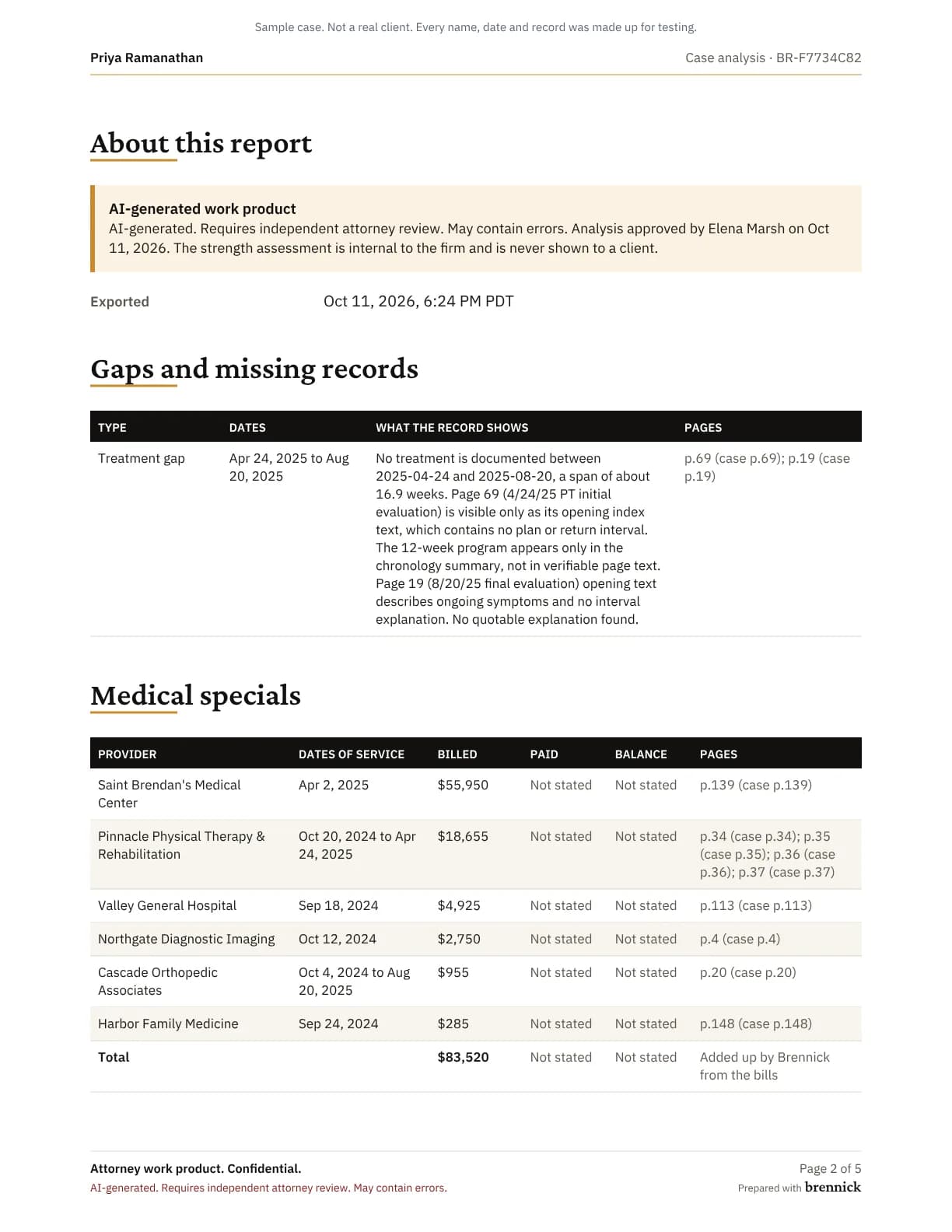
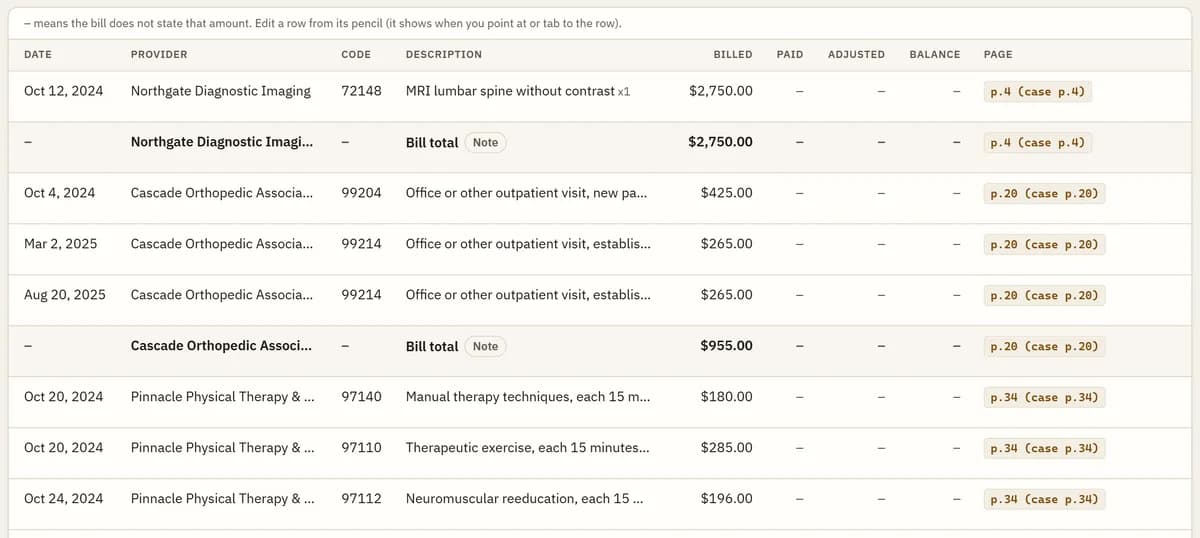
Brennick reads the bills into a charges ledger: itemized statements, UB-04 and CMS-1500 forms and EOBs, with billed, paid and balance amounts where the bill states them. Every amount is checked on its page, a repeated bill is counted once, and totals are added in code.
The estimate uses the specials as billed or as paid, the way the state’s rule measures medical expenses. When that measure needs a figure the bills do not state, the specials are left blank and the reason is listed.
When new bills arrive after an estimate, the case shows the charges found since it, and a licensed attorney can re-estimate.
Checked in code
- The specials must be the ledger’s figure under the measure the estimate names.
- Every dollar figure in the estimate’s text must be the range, the specials or a figure from the bills.
- No lost earnings figure: wage loss is left to your attorney until a figure can be computed from the records.
- A refused estimate is not stored and the refusal is logged. The model gets one retry with the reasons.
Your attorney’s damages review
Every estimate has its own attorney damages review, apart from approving the analysis. Until it is approved, nothing uses the figure: not the demand, not the strategy report, not Ask this case.
To approve an estimate on an AI-researched basis, the attorney ticks “I have checked [State]’s damages rules.” The demand amount is always your attorney’s to set.
FAQs
Which states does it cover?
Every state. California’s rules are verified. In every other state the basis is AI-researched, labelled that way, and your attorney confirms checking it before approving.
Does the demand use the strength score?
No. The demand drafter is not given the strength assessment. Your attorney sets the demand amount, and the specials table in the letter is built from the bills.
Why is there sometimes no range?
There is no range when no usable legal basis is stored, when the case is workers’ compensation, or when the record shows no injury with treatment. The estimate says why.
Can a client see the score or the range?
No. Clients never see a score, a range or an analysis.
Read a damages estimate line by line
3-day trial, 1 case, card required. Check the range, its legal basis and every figure against the bills.