Employment
Employment case analysis: who said what, and when, cited to the page
Brennick reads HR files, emails, texts and pay records and builds a dated timeline of protected activity, notice, adverse actions and comparators. Every entry cites its page, and its quote is checked on that page.
- Protected activitya report, a complaint about pay or safety, protected leave
- Complaintto HR or a manager, dated and quoted
- Adverse actiona write-up, a cut in hours, the termination
Each one dated and cited to its page
Employment events, in order
Each entry is one dated fact, filed under one of five employment categories or under other.
An entry uses the document’s own word for the act, lists everything a complaint was about, and gives every term and condition of an offer, such as a release of claims or a deadline. It never describes anyone’s motive.
Protected activity
A complaint about discrimination, harassment, retaliation, unpaid wages or safety, a report to an agency, or protected leave.
Notice to employer
An HR reply or a manager’s message showing the employer knew of a complaint, a request or a protected status.
Request
An accommodation, leave, a schedule change or an investigation your client asked for.
Adverse action
A warning, a write-up, a cut in hours or pay, a demotion, the termination.
Comparator
How the employer treated another employee in a similar position.
Every quote checked on its page
Each entry carries a short quote copied from the page it cites. Code checks that quote against the page text, and an entry whose quote is not on its page is dropped, never shown. Each entry is dated from the page it cites, never from another document.
A licensed attorney at your firm reviews and approves the timeline before anyone uses it.
The figures on the accuracy page were measured on medical case files, not employment files.
What it reads on an employment case
Each document is labeled by type and by who provided it: your client, your firm, a provider, the other side, a third party or a court. Your staff can change either label. An email’s sender, recipients and date become timeline items marked as read from the email header, not from AI.
Audio and video recordings are stored for your review and playable on the case. They are never read or transcribed.
- HR and personnel records, write-ups and reviews
- Emails, and text or chat message exports
- Policies and handbooks
- Pay stubs, pay records and tax records
- Agency and court filings, contracts and separation agreements
- Medical records, when the case has them, in their own medical timeline
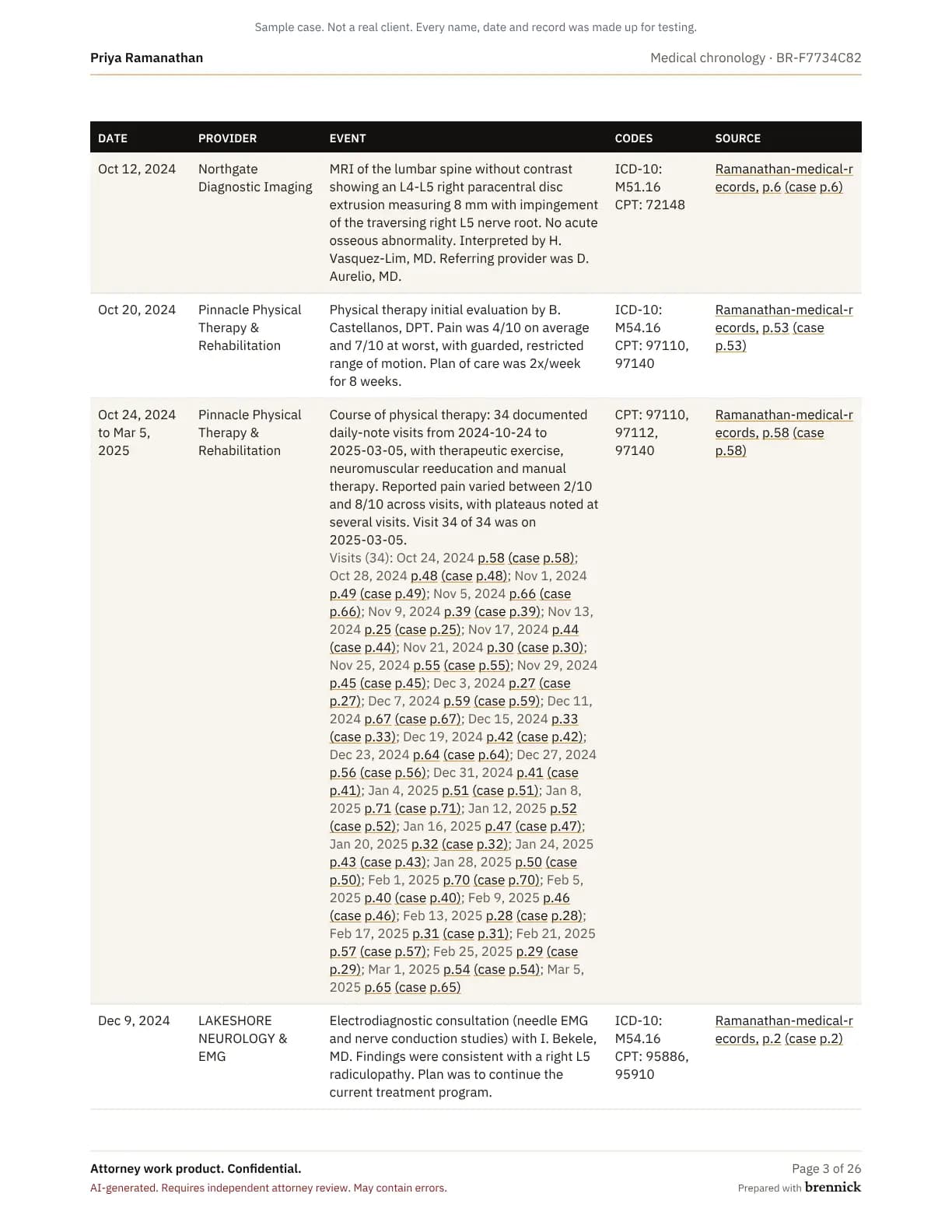
What an exported timeline page looks like
The sample below comes from a sample personal injury file, so its entries are medical. An employment case exports the same way, with each event dated and cited to its page.
Dates your attorney enters
Employment claims run on several clocks at once: agency complaints, notices of the right to sue, wage claims. Brennick calculates none of them, in any state. Your attorney enters the statute of limitations date for each case and can verify it, and Brennick tracks it, emails the people on the case as it approaches and puts it on a connected calendar.
Then work the case
Ask this case
Ask a question and get an answer from the records with its page, or “Not found in the records.”
Ask this caseCase Strategy Report
An attorney-facing report built from the approved timeline and the evidence you have, have asked for and are missing.
Case Strategy ReportDemand letters
A first draft in your firm’s style, told from the case events and cited to their pages. Your attorney sets the amount.
Demand letters
FAQs
Does it work on a case with no medical records?
Yes. A case built on emails, HR records and pay records gets an event timeline with no medical section.
Can it read a text message export or a screenshot?
Yes, when the text is readable: exports as files, and screenshots as images read with OCR.
Does it calculate the deadline to file with an agency?
No. Your attorney enters every employment date.
Who checks the timeline?
A licensed attorney at your firm reviews and approves the analysis before anyone uses it.
Run an employment file you know
3-day trial, 1 case, card required. Bring a case with a long email trail and check the timeline against it.